
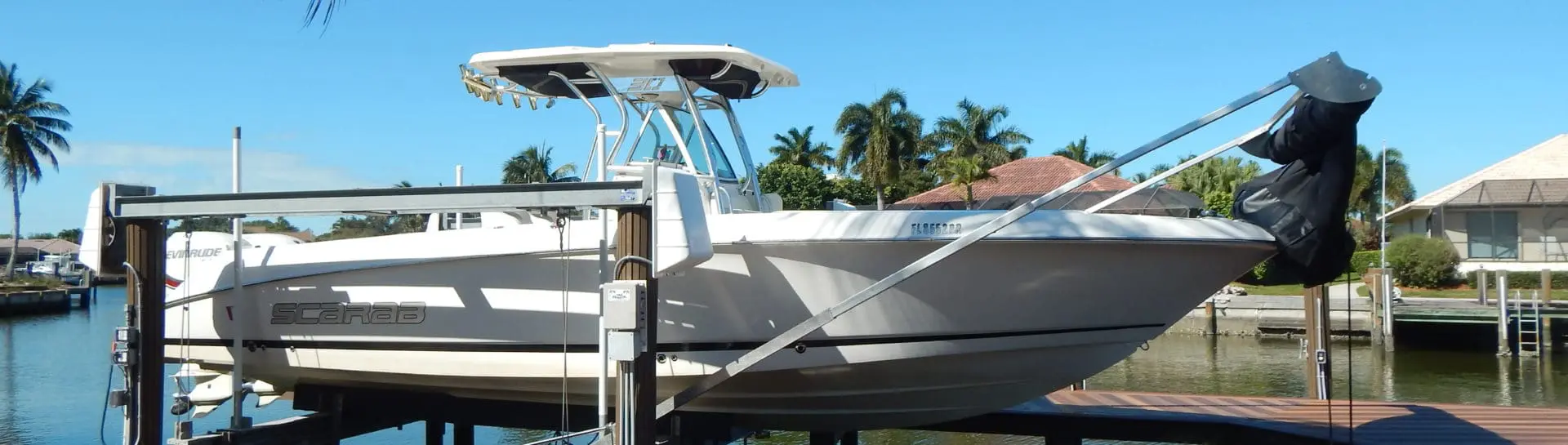
Boat Lift Pros and Cons: The Honest Breakdown
Every boat lift company will tell you a lift is worth it. That’s not surprising: they sell one type of lift, so of course it’s the answer. Sunstream builds freestanding, floating, and piling lifts, so we don’t have a favorite to protect. Here’s what actually changes when you put your boat on a lift, and where each lift type falls short.
What Are the Pros and Cons of a Boat Lift?
Pros
- Keeps your hull out of the water, eliminating algae, barnacles, and marine growth
- Stops gelcoat blistering and eliminates the need for bottom paint
- Launching and landing is a button press. No dock lines, fenders, or trailer ramps
- Protects the hull from wave and wind damage while docked
Cons
- A quality lift is a real investment, it’s not cheap
- Requires maintenance and an annual inspection
- Can be an eyesore and may obstruct waterfront views
3 Real Benefits of Owning a Boat Lift
A cleaner, longer-lasting hull. Boats left in the water grow algae and barnacles within weeks, and constant submersion accelerates gelcoat blistering and corrosion on props, shafts, and through-hulls. Pulling the boat out between trips stops that clock entirely.
Faster in, faster out. With a high speed lift, launching is a button press: no dock lines/fender routine, no backing down a ramp, no waiting in line, no wrestling a trailer winch. A high speed lift enables
Less recurring upkeep. Bottom cleanings and anti-fouling treatments become a regular chore when a boat sits in the water, and prolonged exposure raises the odds of gel coat and hull repairs down the line. A lift doesn’t erase maintenance; it shifts you toward the occasional kind instead of the constant kind.
“The FloatLift just makes boating so easy. No more towing the trailer to the launch ramp to head out for a day cruise. We simply drop the boat in the water and go; then the opposite when we return. Because it keeps the hull bottom out of the salt water, there is no more pulling the boat out and power spraying the hull every 10 days to keep the barnacles off.” Gregory Cain, Sunstream FloatLift owner, Puget Sound, WA (Google review)
That’s the difference in practice: a saltwater environment that used to demand a power-spray every 10 days now needs none, and launching a Boston Whaler is a drop-and-go instead of a ramp trip.
3 Honest Downsides to Consider
Installation is a professional job, not a weekend project. Piling lifts need structurally sound pilings driven and permitted. Even a straightforward freestanding lift benefits from a dealer confirming your bottom composition before anything goes in the water.
Not every lift works on every waterfront. Freestanding lifts may not work if the slope is too steep or the water too deep. Fixed piling lifts need pilings driven into the bottom, which some marinas restrict. Floating lifts solve both problems but need enough slip width for the flotation tanks. Water level swings of more than a few feet can also rule out certain designs. This is the detail most “pros and cons” articles skip.
You still own the maintenance. Cables stretch, motors wear, and hydraulic components eventually need attention. A well-built hydraulic system needs far less routine intervention than a cable-and-pulley system, but “less maintenance” isn’t “no maintenance.”
Which Lift Type Fits Your Water?
This is the question that actually determines whether a lift is worth it, not a generic pros-and-cons list.
| Lift Type | Best For | Watch Out For |
| Freestanding hydraulic: SunLift X
|
Water fluctuation less than 4 ft, fast push-button launch, adjustable bunks for an exact hull fit
|
Needs solid ground for the legs to stand on
|
| Freestanding hydraulic: SunLift Legacy
|
Water fluctuation less than 3.5 ft, straightforward push-button operation on a classic frame
|
Same ground requirements as SunLift X, without the adjustable-bunk fit
|
| Floating: FloatLift
|
Fluctuating water levels of over 3.5 ft, soft or mushy bottoms, tidal saltwater, shallow water down to 12 inches under boat
|
Needs adequate slip width for floats
|
| Piling-mounted: Helix2-P
|
Nice docks wanting a hidden, low profile lift. Pilings available. fastest lift-and-launch in its class. Longest range at 15’
|
Requires structurally sound pilings
|
| Versatile mount: LiftBar
|
Nice Docks wanting a hidden, low-profile lift that bolts to pilings, a fixed dock, or a floating dock, no crane needed
|
Lifting range tops out around 11 feet depending on the model
|
Sunstream also builds two dedicated small-craft options: the drive-on SunPort2 and the freestanding SunLift Mini for personal watercraft, if the boat in question is a PWC or small craft.
If you’re not sure which category fits your dock, that’s a five-minute conversation, not a guessing game. A local dealer can look at your bottom type and water swing and tell you in one visit.
Is a Boat Lift Worth It for You?
Ask these three questions:
- Is your boat value worth it? If you have a nice boat, it is worth protecting with a lift.
- How often do you boat or want to boat? Weekly or more, a lift pays back fast in time saved. A lift also helps you boat more often due to ease of going boating.
- Are you planning on keeping your boat for a long time? A lift keeps your boat newer looking for longer, and reduces hull damage.
FAQ
What are my power options for a boat lift?
Sunstream lifts, are all DC and are charged by low-amp DC trickle charging, or solar, with no dock power required at all. DC and solar setups are safer around the waterfront and give you a built-in battery backup if AC power goes down.
How much water fluctuation can a lift handle?
It depends on the lift. The SunLift X offers up to 6.5 feet of lifting range, enough to handle roughly 4feet of water fluctuation over a season. If your water swings more than that, a FloatLift, Helix2-P, or LiftBar is the better fit.
Floating vs. freestanding vs pile lifts: which is better?
Neither is universally better. Floating lifts are more portable and handle fluctuating water, very deep water and any seabed; freestanding lifts are ideal for fluctuation under 4 ft, and portability is needed for markets with ice. Pile lifts are better for longer lifting range.
Let Your Dock Decide
A boat lift is worth it when your water conditions match the lift type. Get that match wrong, and even the best-built lift will fight your dock instead of helping it. Sunstream builds freestanding, floating, piling-mounted, and versatile-mount lifts, so a dealer can size the right one for your exact conditions instead of the one they happen to sell.
Find a Sunstream dealer near you and get a straight answer on which lift fits your water.