
How Do Boat Lifts Work?
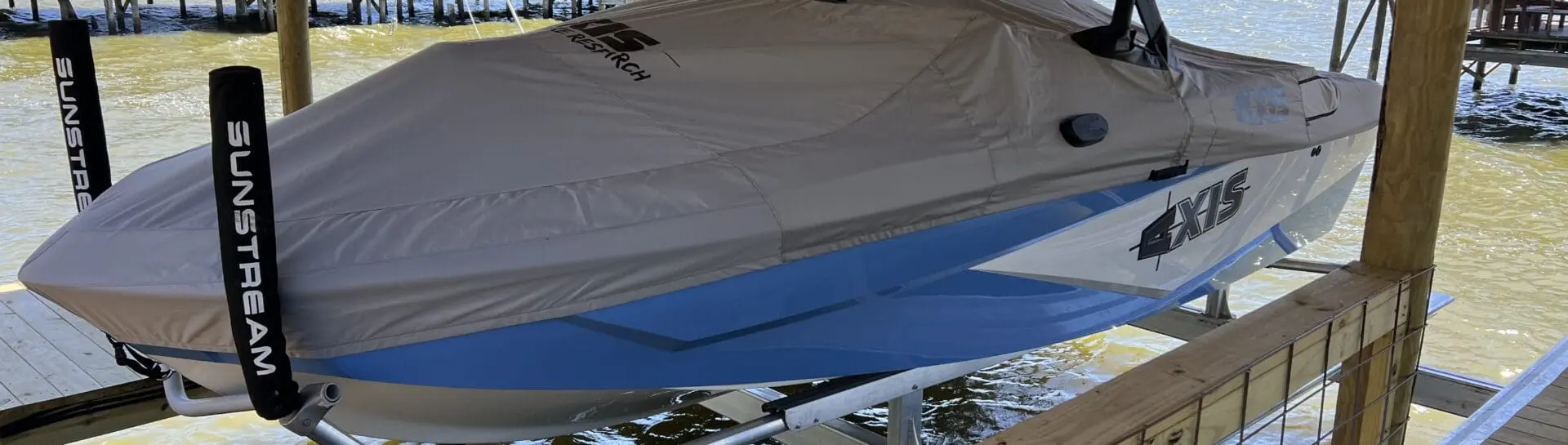
A boat lift is a powered system designed to raise and hold your boat above the water when it’s not in use. Depending on the type, it operates by having the boat typically supported by bunks or slings, being either pushed up by hydraulics or air, or pulled up with a cable, protecting the hull from marine growth, gelcoat pitting, preventing the boat from being damaged and preventing damage from waves. A boat lift also adds convenience with fast departures and landing, with no dock lines or fenders, eliminates the need for bottom paint, and makes boarding safer by keeping the boat stable and steady.
History of Boat Lifts
The first record of a boat lift was in 1789 at the Churprinz mining canal near Dresden, and lifted 2.5 ton. Another interesting historical tidbit is that the only patent a US President ever received was Abraham Lincoln, for a boat lift to help ships pass shallow shoals.
The primary purpose of today’s boat lifts is to keep the boat bottom clean, to keep the boat being damaged in the waves, and make docking easier without fenders, docklines or landing crew.
There is a wide variety of type of mechanisms used to lift boats, since there is a wide variety of waterfront situations, with differences in water fluctuation, depth, icing, bottom condition, permitting, and budget. Every boating region has a subset of lifts that can work, with the main difference being floating, freestanding. piling lifts, elevator (track) lifts, Davit lifts. Within those categories, some lifts push up from the bottom of the boat, and some pull up with cables. Almost all boat lifts are made of marine grade aluminum to prevent rust and for lighter weight.
Floating Lifts
Floating lift categories include: Freefloating, built in Pitman arm, drive on lifts and floating dock lifts. Floating Lifts often used with floating docks.
- FreeFloating Lifts: The two types of freefloating lifts are: Hydraulic Freefloating like the FloatLift, and freefloating air lifts. The Floatlift lifts the boat by pulling an unsinkable foam filled floats under the boat with a pivoting arm pulled by hydraulics. This enables the lift to be used in very shallow water since the floats are not under the boat when lowered. It also prevents the lift from lowering due to air leaks. Hydraulic lifts are DC, and can be charged by AC or solar. Freefloating air lifts operate by pushing air with blowers in multiple tanks. A controller is designed to keep the boat as level as possible when lifting. Freefloating lifts are attached to a dock with dock lines, which makes it super portable, which is ideal for rental markets. The regulatory restrictions are often much less for these lifts. There are AC and DC versions.
- Pitman air lifts: This mechanism uses air tanks under the boat to lift and lower, and the tanks are stabilized with pitman arms attached to a U shaped dock. An air blower is mounted in a pedelstal on the dock and air hoses run to the tanks. These lifts are popular in inland fresh water markets with truss style floating docks MO, TX, OK, KS region. The blower is powered by 110v AC.
- Drive on lifts: Drive on lifts lift a boat without a mechanism by driving the boat on top of a floating platform with rollers, then securing the bow. To launch, untie the bow, and push the boat backwards to start it rolling off and board. Small versions are referred to Ports, and popular with jet skis. This category is best used in protected water only, both fresh or salt. No power is needed for these lifts.
- Floating Dock Lifts: This is a fairly new category, of incorporating a lifting mechanism, like a Sunstream LiftBar into the fingers of a floating dock. This can be used in fresh or salt. The advantage is that it is the only floating lift that the mechanism is completely out of the water which keeps the lift clean and out of the water, which is especially nice for salt water markets. This is an efficient design since it uses the buoyancy of the finger for lift, instead of separate lifting floats or tanks. These are DC powered, charged by AC or solar.
Freestanding Lifts
A freestanding lift is a self-contained lift, that has a lifting mechanism supported by 4 legs with feet on the seabed. These are popular in seasonal areas since they can be easily removed for the winter. The lifting range is 6.5 ft or less, which limits their use for markets with water fluctuation of 4 ft or less. Some are designed for salt water with corrosion resistance and protection from marine growth. Because it is supported with legs, they can typically be installed in depths of 12-21ft max. The feet are pushed into the substrate by the weight of the boat until refusal, but releveling in soft substrate over time is sometimes needed.
- Freestanding hydraulic cantelever lifts: The most popular freestanding lifts, such as the Sunstream SunLift, are now hydraulic ‘cantelever’ lifts which has a parallelogram mechanism that pushes the boat up from the bottom, with underwater hydraulic cylinders push the mechanism up. Nobody knows why they are called ‘cantelever’ lifts, since there is not much cantilevering going on… On some lifts, a boot protects the cylinder shaft from marine growth, which in turn, keeps the hydraulic fluid clean. The 4 bar linkage are often designed such that the bunks angle when lowered, which helps guide and stop the boat when landing like a trailer. These are known for being fast and smooth. All are DC and charged with AC or Solar.
- Freestanding cable lifts: Freestanding cable lifts work by lifting a rectangular cradle, lifted by cables in all 4 corners. The cables can be pulled by a manual or electric winch, or by hydraulic cylinders or by a ball screw. The cradle is often kept horizontal with multiple stabilizing cables.
Piling Lifts
Piling lifts are very popular in markets of with more than 4 ft of seasonal water fluctuation that uses fixed docks. This includes much of the coastlines of the world, and many inland lakes that use piling docks. These operate by having a lifting cradle with bunks being lifted in all 4 corners with cables.
- Traditional (aka ‘old school’) piling lifts: These lifts have been very common for 50 years, and comprise of 4 or more pilings that are typically very tall, with either port and starboard lifting motors turning grooved spindles, or with 4 independent motors turning 4 grooved spindles. The motors must be mounted high enough to keep from being submerged in flooding conditions. The 4 motor configuration is referred to as a ‘beamless’ lift, since it does not have the upper side beam that can get in the way and is in view. These lifts are almost always high amp 220V. Getting power to the far side requires underwater conduit unless there is a U-shaped slip. To help keep the cable from getting tangled, called ‘bird-nesting’ spring loaded plate holds the cable on the grooved spindle Care needs to be taken not to unload the cradle, such as hitting the seabed, since that would cause bird nesting of the cables, so a rotary limit switch is used and adjusted to keep the cradle off the seabed. Upper limit switches prevent over-raising. These lifts are typically high amp 220V
- Hydraulic Cylinder Piling lifts: These lifts use hydraulic cylinders to pull on cables, eliminating the motors on the piles, spindles and bird nesting. Since the cylinders are waterproof, the structure can be mounted out of sight at dock level for a clean look, with only the powerpack showing. This lifts are DC charged by AC or solar.
- Rotary Hydraulic Piling lifts: This was introduced with the Sunstream Helix, which utilized a rotary hydraulic motor, vs electric for much higher speeds and submergibility so it can also be mounted out of sight, except for the powerpack on the dock. These are DC charged by AC or solar.
- Ball screw piling lifts: The Sunstream LiftBar introduced another category, using a motor turning a ball screw. This provided the high speed, hidden structure, but eliminated spindles bird nesting and limit switches. A major advancement is the elimination of the powerpack, with the batteries miniaturized by utilizing regenerative braking charging when lowering. These are DC charged by AC or solar.
- Elevator Lifts (track lifts): Thes lifts are typically used on bulkheads vs docks, since it attaches only on one side of the lift. Typically 2 I-Beam tracks guide wheeled traveler assemblies, that are pulled up with a cable. Electric motors turn a grooved spindle to lift the cables. Rotary limit switches are used to prevent birdnesting of cables if the traveler hits the seabed. Upper limit switches prevent over-raising.
- Davit lifts: These lifts use a rotating crane-like arm that lifts a boat from above with a single cable. A typical 3 point lifting harness is attached to the boat that has a center lifting ring at the center of gravity of the boat.
_______
- Bunk types: Boats on lifts are supported by a wide variety of bunks to support the boat. Low cost options are carpeted wood, typically 2×6 to 2×10. More durable bunks are rubber capped aluminum bunks. Some bunks are inflexible, but more modern bunks are often channel shaped and flexible to conform to the boat and to enable use for boats with stepped hulls. Pontoon boats and catamarans require specialized bunks. One type lifts each toon from below, another type lifts the underdeck of the pontoon boat, which saves water depth.
Accessories:
Popular accessories for lifts are:
- Remote control: Remote control is an important accessory, often included with a lift. It enables you to control the lift from your driver’s seat, so you don’t need to hop out on the dock, that can be dicey in waves. Some lifts have smartphone apps to control, which is handy to control your lift and cover without the boat keys in your pocket.
- Guide ons: These are very important to make positioning on the lift easy, even if drinking…. Some guides are L-shaped and mount to the bunks . Others are vertically straight and mount to the lifting cradle. Some guides, called load guides, are horizontal, like some trailer guides.
- Bow stop: This is a handy accessory to proper position your boat on the lift. It is very important to have the center of gravity of your boat in the middle of your bunks to prevent the lift from tipping.
- Automatic boat covers: Nobody loves boat covers, but they are essential to protect your boat. This accessory, called the Sunstream SwiftShield, puts your custom cover on like a 3d dump truck cover.
- Canopies: Canopies help keep weather that comes vertically off your boat. It does not replace covers though, since there are birds and bugs inside the canopy making droppings. The canopy also does not protect the sides of the boat from the sun.
Using a Mechanical Lift
Even though there is such a wide variety of ilfts, the use of each are remarkably similar. To Depart, one would start lowering the boat with a keyfob, smartphone app or pressing the down button on the physical control box.
Departing From a Mechanical Lift
When the boat is almost fully floating, it is safe to board. The motor is then started, and the lift is lowered the final few inches to release the boat, and the boat is backed off the lift. One can then raise the lift if desired to keep the bunks clean.
Landing on a Mechanical Lift
When landing on the lift, position the bunk height using the remote control just below the water at an elevation that will gently touch the hull to help guide the boat on and slow it down. Marking the guide with a band of electrical tape at the waterline in this position helps to get the height right each time. Putting a sticker or tape on the boat where the guides are helps position the boat fore/aft. When the boat is in place, raise the boat a few inches to secure the boat on the lift. If the boat is not level, lower the cradle and recenter the boat laterally.
Using a Drive-On Lift
Departing From a Drive-On Lift
To depart, untie the bow and push the craft off the boat. Use caution if you try to board a moving boat.
Docking With a Drive-On Lift
When docking, approach the drive on lift slowly and position the bow on the rollers properly. Then apply only enough throttle to power your boat on the lift. Then tie the bow to the lift.